Facebook pixel Part-Time MBA Curriculum | Pepperdine Graziadio Business School Skip to main content
Pepperdine | Graziadio Business School

Part-Time MBA Curriculum

Accelerate Your Career Without Hitting Pause.

The Pepperdine Graziadio Part-Time MBA is designed for working professionals ready to elevate their careers and lead with purpose. We believe you shouldn't have to choose between your education and your career.

Its hybrid format allows students to attend classes on campus some weeks and participate online in others. Additionally, several elective courses are offered fully online, providing even greater flexibility for your busy schedule.

Our program blends rigorous academics with real-world application, empowering you to apply insights immediately at work. Each course is thoughtfully sequenced to reinforce key concepts, ensuring your learning is cumulative, strategic, and applicable to real-world challenges.


Core Curriculum

The Graziadio Business School's Part-Time MBA program requires 52 units of coursework comprised of 36 units of foundation courses and 16 units of electives.

 Personal and Leadership Development Workshop

BSCI 650 (1 unit)

This workshop serves as an orientation toward the experiential and team based models of learning used at Graziadio. Students engage in exercises and reflection that are meant to enhance communication, ethical decision-making, career development and other relevant skills for interpersonal effectiveness in business. It is scheduled over an extended weekend in the greater area near our campus locations. The course is graded credit or no credit, and taken in conjunction with our 4-unit Organizational Behavior and Personal Development course.

 Organizational Behavior and Personal Development

BSCI 652 (4 units)

As students solidify their identity as an ethical practitioner and MBA student (in BSCI 650), you will learn to apply the behavioral sciences to management issues through the integration of conceptual and experiential approaches. This course provides students with increased self-awareness in order to enhance their personal and professional development. Students will reflect on their own skills and values along with learning to effectively collaborate and communicate with others in organizations. Students will develop leadership and teamwork skills that enhance interpersonal dynamics and organizational effectiveness.

 Analytics for Business Decisions

DESC 607 (4 units)

The focus of this course is on the application of analytics for strategic business decision making. The course introduces analytical tools that can be used to leverage data and information for complex problems. The course is designed to support the integration experience and includes an introduction to production and service operations. Specific business modeling applications include: regression analysis, time series forecasting, decision analysis, simulation, linear programming, queuing theory, and project management. These techniques assist managerial decision making in the dynamic and highly competitive world of business, including applications to finance, marketing engineering, manufacturing, quality, service and human resources problems in such industries as health care, aerospace, high technology, entertainment, global business, and banking. Software technologies and spreadsheets are used extensively throughout this course.

 Accounting: The Language of Business

ACCT 606 (4 units)

This course integrates financial and managerial accounting topics to provide a structural model of business and its operation. Financial accounting information is examined as a means to make rational business decisions. Students learn to gauge a firm's position of liquidity and profitability. Business operating cycles are explained. Financial statements are constructed using spreadsheets. Traditional and globally competitive management control systems are critiqued for their utility in guiding management's resource allocation decisions.

 Prices, Profit, and the Market Economy

ECNM 657 (4 units)

The purpose of this course is to develop an economic framework for business managers. It emphasizes the integration of theory, data, and judgment in the analysis of business decisions and government policy, within a changing economic environment. Topics such as pricing, market analysis, forecasting, resource deployment, incentives for innovation, and economic metrics are covered.

 Managing Corporate Financial Resources

FINC 603 (4 units)

This course explores financial decision making within businesses, including how to raise capital, invest capital, and pay out earnings to owners. Risk and reward from investing is considered, in order to assign value to stocks, bonds, and projects or companies. Students will learn how to measure a project or company's cost of capital. Firm capital structure will be covered, along with dividend payments and stock repurchases. Students will also use financial ratios to analyze the performance of companies and recommend courses of action. The course will provide an overview of how corporations are governed, and the structure of the financial system.

 The Art and Science of Marketing

MKTG 603 (4 units)

Marketing is a company-wide undertaking which informs an organization's vision, mission, and strategic planning. It begins with an understanding of what the market looks like and entails a sequence of key decisions, including: Who is our target customer? What specific customer needs are we going to satisfy with ourofferings? How should we set and adapt our prices? What channels of distribution should we use? What means do we use to communicate with our customers? How do we gain and retain customers? In some aspects, marketing follows systematic and scientific approaches to answer these questions. However, there are elements of marketing which are impossible to measure and therefore an artistic exercise.

The purpose of this course is to both educate and excite students about the world of marketing. Businesses today face a number of challenges and opportunities including globalization, the effects of advances in technology, and increased competition. In today's rapidly changing environment, a deep understanding of marketing concepts will help organizations develop and maintain their competitive advantage. Emphasis in this course is placed on the practical application of marketing concepts to solve business problems.

 Competition and Executive Decision-Making

STGY 612 (1 units)

This course provides students hands-on experience managing a business cross-functionally in a competitive environment. The course introduces the concept of business models, which describe how an organization creates, delivers, and captures value, and business strategy, which outlines the high-level vision for achieving a company's goals. Teams will apply the concepts and compete against each other in a simulated environment to improve overall organizational performance and increase long-term value.

 Technology Management and Digital Innovation

ISTM 602 (4 units)

Digital technology is now enmeshed in the fabric of business. Companies in all industries will continue to employ large datasets and powerful digital technologies to transform the way they do business. Business strategy must be fused with digital strategy and leaders must be well-versed in the fundamentals of digital systems and how they can be used to innovate.

This course will prepare business leaders for the opportunities and challenges that data and digital technologies offer. The course will cover foundational technology concepts like data management, how emerging technologies impact customer facing and back end processes, including supply chain management and cybersecurity, among others. The overarching focus of the course will be to prepare leaders to understand systems, analyze data, use technology for innovation, and make sound technology investment decisions.

 Fundamentals of Business Law and Ethics

LEGL 611 (2 units)

This course lays the essential foundation for the student to understand and navigate the complex modern legal, regulatory, and ethical business environment. It addresses the legal process encountered in business litigation, including alternative dispute resolution. The course explores the basic structure of the American federal and state-level legal and regulatory systems and briefly covers substantive law and related ethical considerations in areas that apply to the private business sector, such as: contract law, agency law, business organizations, intellectual property law, tort law, and criminal law.

 Strategic Management

STGY 659 (4 units)

Strategic Management is a capstone course that examines an enterprise from the CEO's point of view. It is designed to help students conduct external and internal assessments of an organization, pinpoint key strategic issues, identify and choose from alternative strategies, and defend those decisions. We illuminate the interplay among an organization's structure, culture, technology, and the global environment through experiential learning techniques like case studies and a project that addresses the issues of an existing company.

By integrating all subject matter covered thus far in your MBA curriculum, Strategic Management provides a foundational understanding for managing change from a top-level perspective.


Concentrations and Specializations

Customize your Part-Time MBA by selecting electives that align with your career goals. All students complete 16 units of elective coursework, which can be applied toward a specialization (6 units) or a concentration (12 units) in a specific area. Courses are offered through a flexible mix of in-person and online formats, with some available fully online.


Take the Next Step

Learn more about how to achieve your career goals with the Pepperdine Graziadio Part‑Time MBA program.


What Can Students Expect?

Our program was shaped by the belief that leadership is best developed through a blend of rigorous academic training and real-world application. We drew inspiration from our Southern California business community, our deep ties to entrepreneurial and values-driven leadership, and our mission to prepare students not just to succeed in business — but to lead with integrity.


Personalized Learning Journey

We offer a highly flexible experience. Tailor your degree with concentrations, global learning experiences, various course delivery options (including hybrid and online electives), and a completion plan that fits your unique schedule and goals.


Engaging Learning Environment

Benefit from small class sizes and continuous engagement with our faculty. Our collaborative culture ensures you're known, challenged, and fully supported throughout your academic journey.


Values-Centered Leadership

Beyond core business skills, we cultivate leaders who understand the human side of business. You'll develop the competence and conscience to drive change with integrity, ready to inspire trust and navigate complexity.


Real-World Project Experience

Engage in Education to Business (E2B) projects, partnering with real companies on actual business challenges. Act as a consultant, developing solutions and gaining invaluable experience, expanding your network, and showcasing your skills.


Immediate Career Application

Every course is designed for direct applicability. What you learn in the evening, you can often put into practice at work the very next day, ensuring your education directly enhances your professional performance.


Strong Community & Connections

Build lasting relationships through active classroom engagement, group projects, and a variety of student clubs. Connect with peers who share your interests and aspirations, fostering a powerful professional network.


Balancing Theory and Hands-On Experience

Our curriculum expertly blends underlying business concepts and theory with their real-world application.
This is reinforced through:

  • Organizational Behavior Workshop: Immerse yourself in an intensive weekend experience, often at the program's outset, where you'll connect with peers, reflect on your leadership style, and learn effective teamwork strategies.
  • Industry Expert Guest Speakers: Learn directly from current business leaders who share practical insights and emerging trends.
  • Industry-Collaborative Learning: Work on real-world projects like Pepperdine E2BTM, where you help solve actual business challenges for partner organizations.
  • Case Studies: Analyze real scenarios to strengthen your critical thinking, strategic decision-making, and problem-solving skills.
  • Simulations: Apply what you've learned in a dynamic environment. The Strategy Simulation integrates core concepts such as finance, marketing, and operations into a high-pressure, team-based challenge that mirrors real business complexity.

PTMBA teacher with small class


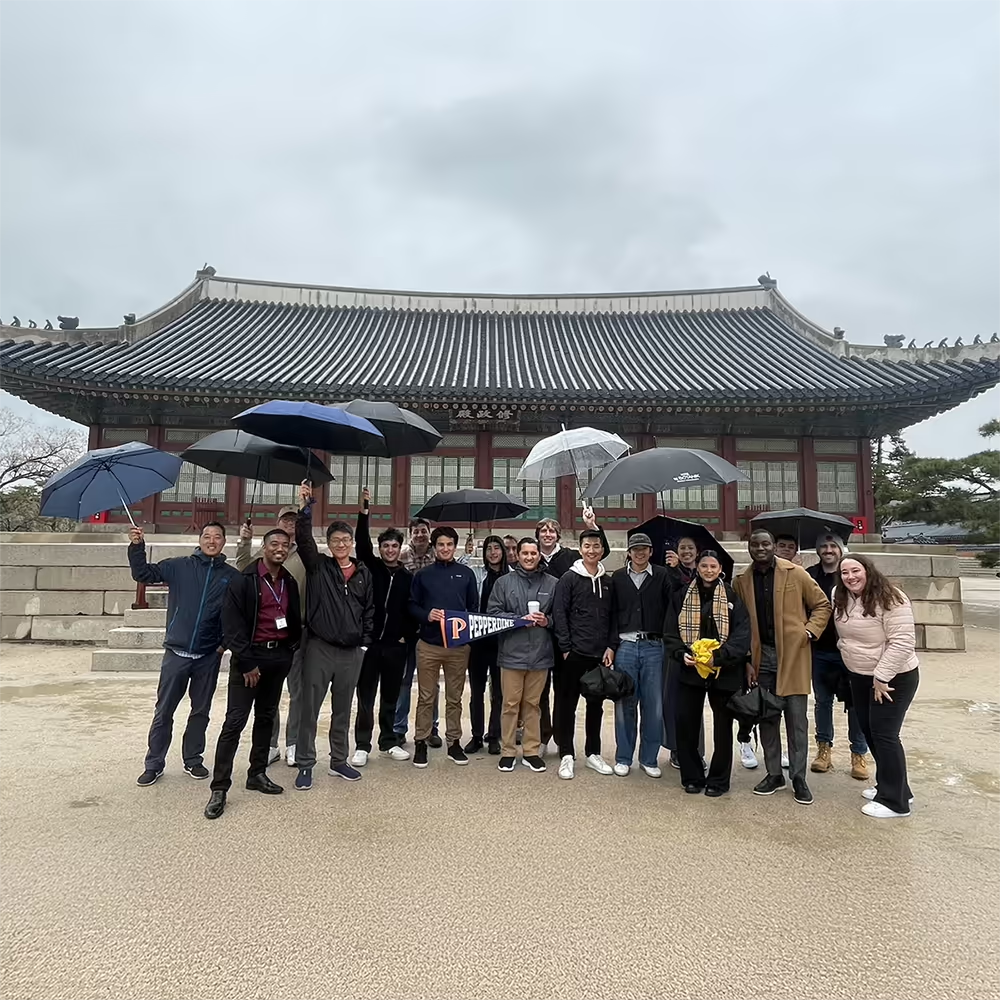
PTMBA students in South Korea


Learn in Global Destination

Our Part-Time MBA program includes opportunities to broaden your perspective through immersive international learning experiences.

One of the program's most popular electives features a week-long Global Business Intensive (GBI), where students travel abroad to engage directly with international businesses, policy leaders, and diverse economic systems. You'll explore how cultural, regulatory, and economic factors shape global markets while building relationships with peers and professionals from around the world.


Frequently Asked Questions

  How is the curriculum structured?

Courses are intentionally sequenced to build on one another. Year one focuses on foundational business knowledge, while year two expands your expertise through advanced coursework and electives in your chosen concentration. View the Part-Time MBA foundational course list.

  What is the learning environment like?

With small classes and supportive faculty, you'll build strong connections in a collaborative setting. Our hybrid model offers the flexibility to balance work, life, and school.

  Will I get hands-on experience?

Yes. You'll apply your learning through real client projects like Pepperdine E2B™, case studies, strategy simulations, and interactive workshops—all designed to strengthen critical thinking and decision-making.

  Are there global opportunities?

Yes. Through participating in the Global Business Intensive (GBI), you'll spend a week abroad, engaging directly with global businesses and economic systems.

  What makes the Pepperdine Part-Time MBA unique?

In our Part-Time MBA program, you'll benefit from flexible scheduling, hybrid and online course options, real-world learning, and a values-based approach to leadership development.

  How will this program support my career goals?

You'll gain tools you can use immediately in your current role, while also preparing for long-term leadership success. Whether you're pivoting industries, growing in your organization, or launching a venture, the Graziadio MBA helps you lead with purpose and impact.