Facebook pixel MS in Business Curriculum | Pepperdine Graziadio Business School Skip to main content
Pepperdine | Graziadio Business School

Master of Science in Business Curriculum

Build the Business Foundation You Need—No Matter Your Major.

The Pepperdine Graziadio Master of Science in Business (MSB) is designed for recent graduates and early-career professionals from any academic background who want to gain essential business knowledge and launch their careers with confidence.

Completed in just one year, the MSB program delivers a comprehensive, cohort-based experience on our Malibu campus. Students build a strong foundation in core business disciplines while developing professional communication, leadership, and collaboration skills.

Our curriculum blends rigorous academics with hands-on, experiential learning. From generating new venture ideas to analyzing real-world business data, each course is designed to be practical, relevant, and immediately applicable. With a strong emphasis on technology, ethics, and innovation, students graduate prepared to navigate today’s dynamic business environment.


Core Curriculum

The Graziadio Business School’s MS in Business program is a full-time, three-term program that combines foundational coursework with electives and experiential learning opportunities.

Students progress through the program as a cohort, building knowledge sequentially across three integrated terms: New Opportunities (Fall), Real and Ideal (Spring), and Strategy and Beyond (Summer).

Fall Term: New Opportunities

The first term introduces core business principles while developing leadership, communication, and entrepreneurial thinking.

  Personal Development Workshop


BSCI 650 (1 unit)

This workshop introduces students to Graziadio’s experiential and team-based learning model. Through guided reflection and exercises, students strengthen communication, ethical decision-making, and interpersonal effectiveness.

  Personal Development for Leadership


BSCI 607 (2 units)

Students develop a personal leadership framework by exploring leadership models, values, and interpersonal effectiveness. The course includes a required residential communication workshop experience.

  Financial Accounting


ACCT 591 (2 units)

This course provides foundational accounting knowledge, including financial reporting, cash flow analysis, and valuation of resources.

  Entrepreneurship and the Generation of New Venture Ideas


ENTR 661 (2 units)

Students explore innovation and entrepreneurship, learning how to identify opportunities, develop business ideas, and pitch new ventures.

  Technology and Operations Management


ISTM 619 (3 units)

This course examines how organizations use technology and data to create strategic advantage, with an emphasis on digital transformation and operations.

  Marketing Management


MKTG 626 (3 units)

Students learn how organizations develop and execute marketing strategies, including customer insights, product development, and brand management.

  Audio, Video, and Digital Business Presentation Tools


PGBS 620 (2 units)

This course builds professional communication skills using modern presentation tools and technologies, preparing students to deliver compelling business messages.


Spring Term: Real and Ideal

The second term focuses on building analytical and functional expertise while applying business concepts to real-world challenges.

  Applied Data Analysis


DESC 593 (2 units)

Students develop statistical analysis skills to interpret data and support business decision-making.

  Managerial Finance


FINC 629 (3 units)

This course explores financial decision-making, including capital budgeting, risk assessment, and valuation.

  Introduction to the Fundamentals of American Law and Ethics


LEGL 627 (2 units)

Students examine the legal and ethical frameworks that shape business operations and decision-making.

  Theories and Models of Organizatio


OTMT 608 (2 units)

This course introduces organizational design and management theories, helping students understand how organizations operate and adapt.

  Economic Concepts

ECNM 592 (2 units)

Students learn core microeconomic principles and apply economic reasoning to business and societal challenges.

  Electives


Electives (4 units)

Elective course availability will vary per term and year based on instructor availability, enrollment, and program needs. Although elective courses are not guaranteed to be scheduled on a regular cycle, students will be provided a choice of relevant options from the program’s elective list during course registration.


Summer Term: Strategy and Beyond

The final term expands strategic thinking and allows students to deepen their expertise through electives and specialized topics.

  Strategic Thinking and Tactical Planning


STGY 622 (2 units)

Students explore strategic decision-making in dynamic, global markets, focusing on long-term planning, innovation, and competitive positioning.

  Real Estate Investing and Finance


FINC 635 (2 units)

This course covers methods of property valuation and acquisition for investment purposes within a portfolio optimization concept. Financing sources and techniques are examined from a strategic acquisition perspective. Issues related to property management, maintenance, and collections also are explored. The tax implications of holding real property are applied to the investment decision to maximize the returns to the investor.

  Designing, Sourcing, and Building Digital Platforms


ISTM 661 (2 units)

In a global business environment, managers must understand the alignment of technology and business functions. There is increasing emphasis on managing enterprise architecture and infrastructure from the perspectives of business enablement, business continuity and risk management. Today’s corporate technology environments are exceedingly complex, involving challenging portfolios of inflexible legacy systems and dynamic mobile applications that span on-premise and cloud installations. Together, these are causing IT systems management focus to shift from “develop and operate” to “source and deploy.” Organizations need systematic approaches for integrating diverse functional areas into a holistic, application-and data focused enterprise-wide digital platform for supporting the business. This course will cover the areas of Enterprise Architecture and Infrastructure Management as essential approaches for the development of coherent, robust, efficient and agile enterprise digital platforms.

  Additional Electives


Students complete additional elective coursework to further specialize their knowledge and skills.

Students may also explore bridge opportunities into specialized master’s programs such as finance, global business, real estate, or business analytics.


Take the Next Step

Learn more about how to achieve your career goals with the Pepperdine Graziadio Master of Science in Business Program.


What Can Students Expect?


Designed for Any Background

Gain essential business knowledge regardless of your undergraduate major, from the arts to STEM fields.


Engaging Learning Environment

Benefit from small class sizes and continuous engagement with our faculty. Our collaborative culture ensures you're known, challenged, and fully supported throughout your academic journey.


Industry-Ready Skill Development

Build practical skills in communication, analytics, finance, marketing, and technology that employers value.


Experiential Learning Approach

Engage in hands-on projects, presentations, and applied coursework designed to mirror real business challenges.


Career Development Support

Work closely with career services to refine your professional goals, build your resume, and prepare for job opportunities.


Strong Community & Connections 

Build lasting relationships through active classroom engagement, group projects, and a variety of student clubs. Connect with peers who share your interests and aspirations, fostering a powerful professional network.


Balancing Theory and Hands-On Experience

The MSB curriculum integrates foundational theory with applied learning to ensure students are prepared for real-world business environments.


  • Leadership and Communication Workshop: Begin the program with an immersive workshop focused on leadership, communication, and collaboration.
  • Entrepreneurial Projects: Develop and pitch new venture ideas, gaining hands-on experience in innovation and business creation.
  • Data-Driven Decision Making: Apply analytical tools in courses like Applied Data Analysis to solve real business problems.
  • Case Studies and Applied Learning: Engage with real-world business scenarios across disciplines, strengthening critical thinking and problem-solving skills.

PTMBA teacher with small class


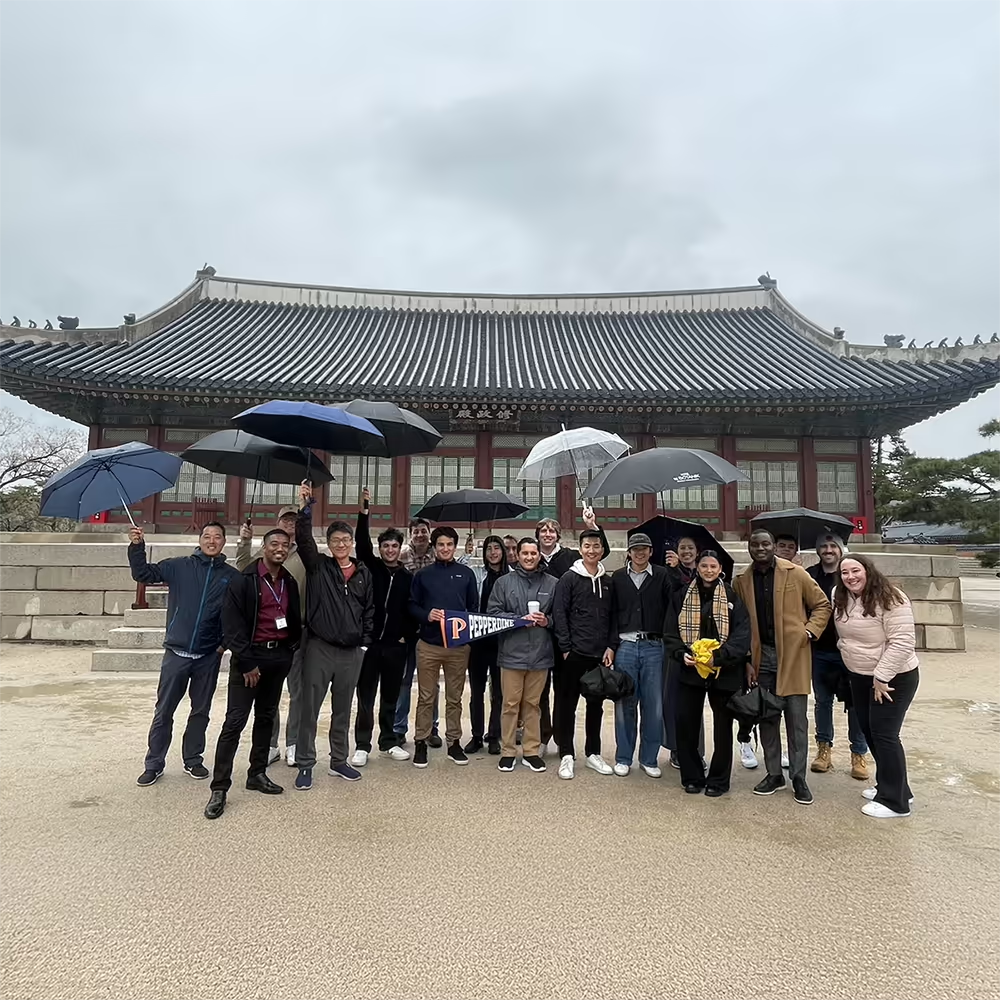
PTMBA students in South Korea


Learn in Global Destination

Our MSB program includes opportunities to broaden your perspective through immersive international learning experiences.

One of the program’s most popular electives features a week-long Global Business Intensive (GBI), where students travel abroad to engage directly with international businesses, policy leaders, and diverse economic systems. You'll explore how cultural, regulatory, and economic factors shape global markets while building relationships with peers and professionals from around the world.

Whether you're visiting financial institutions in London, startups in Berlin, or supply chains in Singapore, these experiences equip you with a sharper, more nuanced understanding of global business strategy, giving you the insight to lead confidently across borders.


Frequently Asked Questions

  What makes the Pepperdine MSB program unique?

The MSB offers a one-year, cohort-based experience designed for students without a business background, combining foundational learning with hands-on application.

  How is the curriculum structured?

The program is divided into three terms—Fall, Spring, and Summer—progressing from foundational concepts to applied learning and strategic thinking.

  Will I get hands-on experience?

Yes. Students engage in experiential learning through projects, presentations, and applied coursework across all terms.

  Are there opportunities to specialize?

Students can select electives aligned with their interests and may pursue bridge pathways into specialized master’s programs.

  What is the learning environment like?

Students learn in a collaborative, in-person setting on the Malibu campus, supported by faculty and peers in a cohort model.

  How will this program support my career goals?

The MSB equips students with foundational business skills, professional communication abilities, and career development support to help them secure entry-level roles across industries.