Full-Time MBA Student Namya Sandal Explores Business, Sustainability, and Leadership in Spain
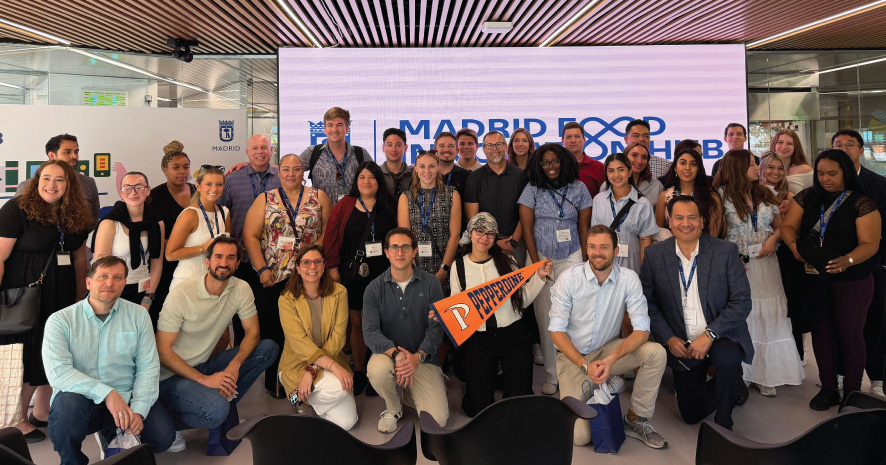
Global immersion experiences offer Pepperdine Graziadio students the opportunity to expand their perspectives, challenge assumptions, and deepen their understanding of international business and leadership. For Namya Sandal, an international student from Canada pursuing her Full-Time MBA with a marketing concentration, a recent experience in Madrid became far more than a long-awaited study-abroad opportunity; it became a transformative lesson in global business, sustainability, and personal growth.
A Different Perspective on Capitalism
Pepperdine’s Global Business Intensive (GBI) to Spain opened my eyes to something I hadn't expected: international business isn't just a scaled version of what we do at home in the US and Canada. It requires a fundamental shift in how we think about competition, value creation, and what companies are actually supposed to do.
This became clear during the opening presentation from Mario Weitz, General Manager of Consulta Abierta and Advisor to the World Bank. While he outlined Spain's economic landscape, strong in green economy and infrastructure, challenged by demographic decline and pension pressures, it was the implications that surprised me most. Spain's regulatory environment doesn't just encourage sustainability, it prioritizes it as central to long-term value creation in ways that American and Canadian markets largely do not.
When we visited the Port of Barcelona and learned about Escola Europea's clean crew strategy, I saw this philosophy in action. In logistics operations back home, sustainability might be framed as risk mitigation or a brand differentiator. Here, it was presented as an operational philosophy, integral to how the company coordinates with government, stakeholders, and customers. The difference reflects a European regulatory context where environmental standards are stricter, where government/industry relationships involve collaborative goal setting around sustainability, and where public expectations about corporate responsibility run deeper.
A New Rhythm of Business
Beyond the classrooms, I noticed something equally interesting: the pace of business culture itself.
Dining in Spain felt more leisurely. Conversations with shopkeepers were genuine. Our cohort quickly adapted to treating business transactions as inherently relational, something that can feel lost back home, where we often prioritize transaction speed over relationship building. This wasn't just cultural flavor; it reflected a shared philosophy about work/life balance and what business is fundamentally for.
At Madrid's Food Innovation Hub, we learned that Spanish startups operate with fundamentally different frameworks than those we encounter in Silicon Valley-minded ecosystems. Longer time horizons. Greater emphasis on sustainability from the outset. Less obsession with hypergrowth at all costs. These weren't quirks of Spanish entrepreneurship; they were windows into completely different value systems about how companies should compete and what success actually means.
The lesson was clear: Competing internationally requires far more than adapting products to local markets. It demands understanding and respecting fundamentally different assumptions about business purpose, stakeholder accountability, and value creation beyond shareholder returns.
Sustainability as Strategy
One of the most transformative lessons from the trip was seeing how Spanish companies approach sustainability, not as compliance, but as a competitive advantage.
In North America, sustainability initiatives can sometimes feel reactive or performative. In Spain, I observed companies embedding sustainability directly into their business models and long-term strategies.
This was especially evident during visits with ISIFARMER and Torres Family Winery.
ISIFARMER, a sustainable agriculture startup, didn't start with a mission and then seek a market. They identified a genuine market opportunity for sustainably produced, traceable agriculture at scale. Their competitive advantage is sustainability itself, water conservation, crop rotation practices, and traceable supply chains. Their value proposition isn't "buy from us because we're green." It's "buy our produce because it's better from every perspective, taste, nutrition, environmental impact, and long-term cost." Sustainability is their strategic differentiation.
Torres Family Winery approached eco-conscious practices not as a trend but as vital to brand positioning and long-term viability. Their commitment to careful water management and soil health investment created a product that resonated with conscious European consumers and drove their success over decades. Their family business model naturally aligned with sustainability philosophy, making it inseparable from who they are.
These examples illustrate a critical distinction. In European markets, sustainability isn't a cost center. It's a source of innovation, brand differentiation, operational efficiency, and long-term value creation. American and Canadian companies often approach it as an expense or external pressure. Spanish and European companies see it as an opportunity.
This matters because it shapes how companies invest, innovate, and compete.
Redefining Leadership Through Global Experience
Walking through Barcelona and Madrid with my cohort, I came face-to-face with gaps in my own competencies. I arrived with basic marketing skills and leadership experience, but with limited exposure to cross-cultural business dynamics and minimal understanding of how a value-driven business strategy operates at an international level.
Being in an environment where I didn't know the language forced me to think differently. Not knowing Spanish highlighted how much I rely on linguistic fluency to navigate the world, and how much intellectual flexibility I need to develop to lead globally.
The Spain GBI clarified what I need to become as a leader, someone with deeper cultural intelligence, not superficial understanding, but genuine comprehension of how different institutions, values, and decision-making processes shape organizational behavior. Someone willing to challenge assumptions about what "good business" actually means. Someone who can recognize that global leadership requires intellectual flexibility, curiosity, and humility.
A Broader Global Perspective
I left for Spain believing I was fulfilling a long-awaited travel goal. I returned with something far more valuable: a deeper understanding of global leadership and the kind of business professional I aspire to become.
The Spain GBI wasn't just a week of company visits and presentations. It was an in-depth education in how different institutional and cultural contexts shape what business excellence and success actually look like. It showed me that sustainability can be a competitive advantage rather than a constraint. It proved that relationship-building isn't inefficient; it's fundamental to international business.
Most importantly, it expanded my toolkit for leading in a globally interconnected economy where success requires cultural intelligence, systems thinking, and the courage to question the assumptions we bring from home.
For students considering a Global Business Intensive experience, I’d urge you to apply. Beyond the travel opportunity, it offers the chance to rethink what leadership, innovation, and business success can look like on a global scale.