Inside the Bryant Stibel Program: Where Graziadio MBAs Learn to Defend Their Thesis
Some of the most valuable lessons don't come from a case study, they come from standing in front of investors who have every reason to poke holes in your argument. That's the premise behind the Bryant Stibel Internship Program at Pepperdine Graziadio Business School, which pairs a rigorous alternative investments curriculum with a live internship inside a working investment team.
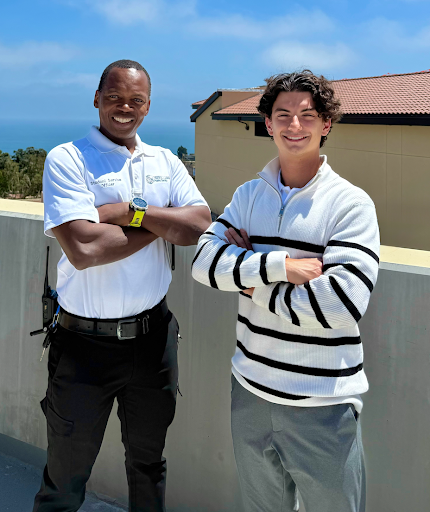
The program is built around a simple but demanding idea: students aren't just learning the mechanics of valuation and portfolio construction, they build real investment theses, present them to a room of experienced investors, and defend every assumption under scrutiny. We caught up with the two students who were selected from this year’s Bryant Stibel cohort, Javi Cordero, MSAF ‘26, and Marvin Nyadzayo, MBA ‘27, about what the experience actually demanded of them.

"The internship taught me that rigorous financial analysis only matters if you can translate it into a decision someone can actually act on." - Javi Cordero, MSAF '26
A Classroom That Doesn't Let You Coast
Both students describe the coursework as demanding in a way that pushed them past what they'd already mastered coming in.
For Javi, who arrived with a background in markets and trade support, the challenge wasn't the technical foundation, it was building conviction from scratch. "The coursework was demanding in the best way, it forced me to move fast while staying precise," he says. "I had to sharpen how I think about valuation, competitive positioning, and what actually drives a company's economics, not just the numbers on the page."
Marvin's experience carried a heavier research load from the start. "We had two to three chapters of the Alternative Investment manual to work through and a weekly essay to synthesize our individual learning," he explains. On top of that, students spent the first seven weeks networking with CIOs across the country to understand how they apply alternative investment techniques to university endowment funds, turning the coursework into an exercise in real world relationship building before the internship even began.
Presenting to Investors Who Actually Push Back
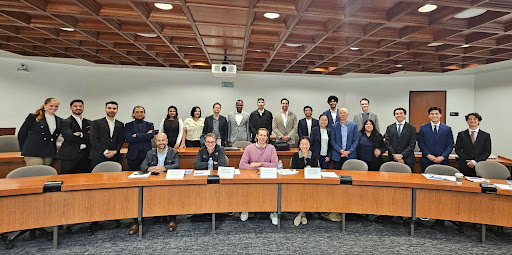
Every student in the program eventually has to stand in front of a panel of investors and defend a thesis in real time. Neither Javi nor Marvin describes that moment as comfortable, but both point to it as where the real learning happened.
"Presenting to experienced investors is humbling," Javi says. "You learn quickly that a thesis has to survive real scrutiny, and vague answers don't hold up. The biggest takeaway was learning to defend my reasoning under pressure and to be honest about what I didn't know rather than talk around it."
Marvin credits the faculty for making that pressure survivable. "Presenting to a group of established professionals is genuinely anxiety provoking, but we had great support from Professor Accomazzo and Professor Kownatzki, who brought in a plethora of experts to listen to our draft presentations every fortnight, grill us on our assumptions, and reset our technique so we could dive into the final presentation well versed from our practice runs."
The Work That Made Them Proudest
Asked what they'd point to as their best work from the program, both students landed on projects that forced them to carry an idea from a rough starting point all the way to a defensible recommendation.
Javi built a full take-private thesis on a public company, a reverse DCF, peer benchmarking, and a complete pitch deck. "Pulling the whole thing together, from the initial screen to a defensible recommendation, is the work I'm proudest of because it tied together everything I'd been learning in class."
Marvin's standout project involved evaluating an AI-driven venture seeking private funding, one that was outperforming much larger competitors and had far more future innovations in the pipeline than a typical early-stage company. "There were so many options and directions to choose, which became a challenge, albeit a fantastic problem to have," he says of the process of narrowing down valuation and positioning without a clean set of comparables to lean on.
What Surprised Them About the Work
Coming in, both students expected the job to be mostly quantitative. What surprised them was how much of it wasn't.
"I expected it to be mostly modeling, but a huge part is judgment, reading a management team, understanding a market's trajectory, and weighing risks that don't fit neatly into a spreadsheet," Javi says.
Marvin found a similar gap between theory and practice when working with companies that didn't have clean financials to lean on. "Trying to establish a value with no SEC financials was tough, but it helped me improve my use of comparative models and peers to project key decision-making information."
Where the Classroom and the Desk Meet
Both students say the internship gave weight to material that had previously lived mostly in lecture slides.
"It made the coursework concrete," Javi says. "Concepts from my finance modeling, portfolio management, and derivatives classes stopped being abstract once I was applying them to live deals. It also reinforced how much the fundamentals matter when you're making an actual call."
Marvin points directly to the tools and training that carried over. "Using the great tools provided by the school, the access to Bloomberg Terminals, the Capital IQ subscription, and much more academic material, as well as the techniques learned and practiced in Professor Hauk's Accounting class and Professor Walton's Modeling class, really prepared me to hit the ground running, and outlined where I need to spend more time next semester to build on the gaps I perceived during my internship."
Advice for the Next Intern
Asked what they'd tell the student stepping into the role next, both answers came down to the same instinct: show up with a point of view, and don't fake certainty you don't have.
"Do the reading and show up with a point of view," Javi says. "Nobody expects you to be right every time, but they do expect you to think for yourself and defend your reasoning. Be honest about what you don't know, that's how you actually learn here."
Marvin's advice leans into the network Pepperdine puts within reach. "Take the time to talk to professionals in the industry, especially around Pepperdine with all the conferences hosted onsite, the Coastal Capital Summit, the Pepperdine Most Fundable Companies competition, and the Data Analytics Hackathons hosted by the professors.”

“Use the opportunities while you're on campus, as they all enhance your knowledge and add an asset you can deploy when called upon during your internship." - Marvin Nyadzayo, MBA ‘27
The Takeaway
What Javi and Marvin describe isn't a program that hands students a playbook, it's one that puts them in front of people who will ask the hard question, and expects them to have an answer. As Marvin put it, reflecting on the mentorship that shaped his experience most: build relationships early, because "you never know which random chat at the airport, cafe, or pool will lead to a business proposal."
For both students, the Bryant Stibel Internship confirmed something less about a specific career path and more about the discipline required to hold one. As Javi puts it, the habit of "building a thesis from the ground up is something I'll carry into whatever I do."
Learn more about how programs like the Bryant Stibel Internship help Pepperdine Graziadio MBA and MS in Applied Finance students build real investment experience alongside their coursework.